
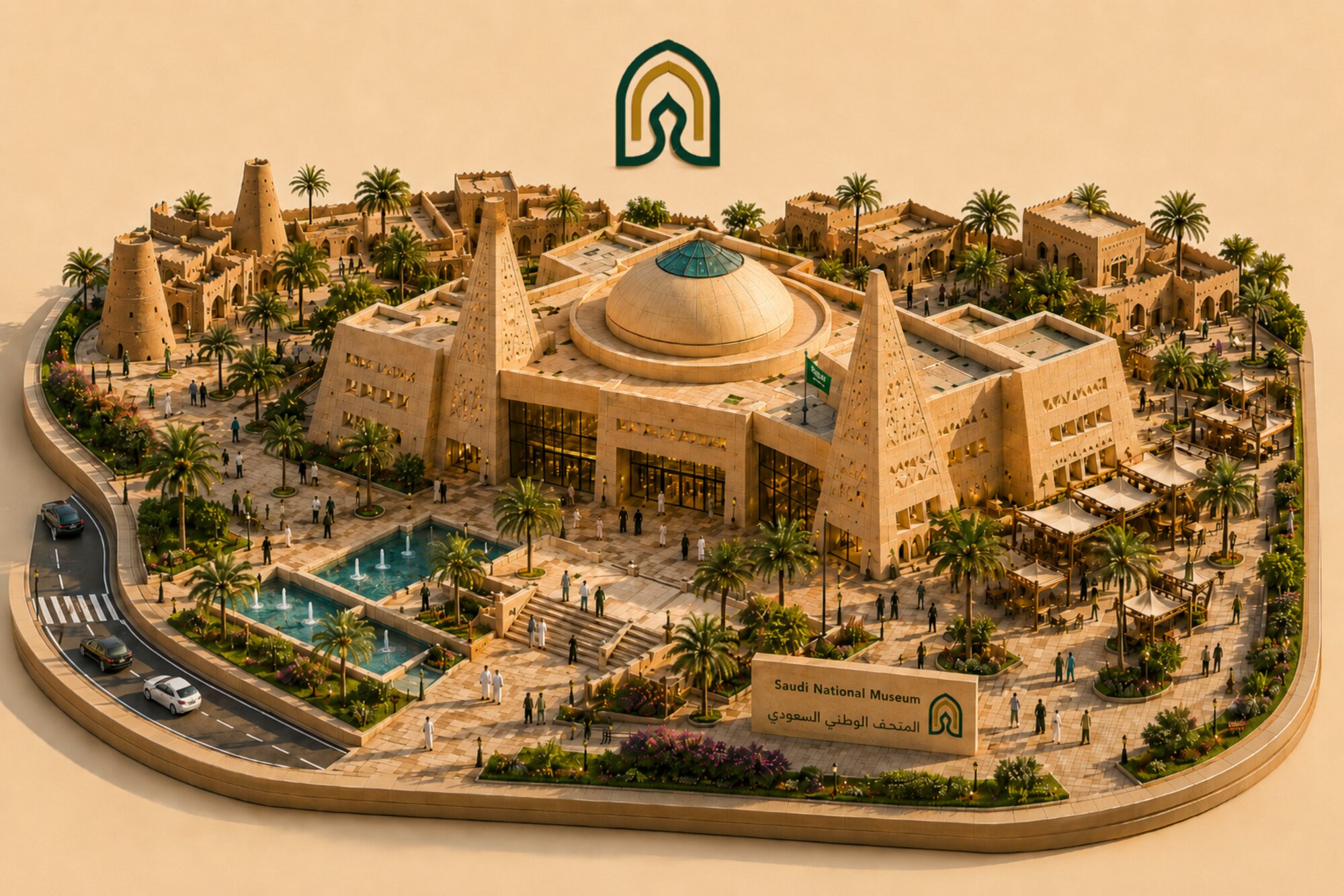
The National Museum of Saudi Arabia
A journey through the history of the Kingdom and the Arabian Peninsula
About
The flagship national museum in Riyadh, set within the King Abdulaziz Historical Center in Al Murabba. Its galleries present the long story of the Arabian Peninsula — from early human settlement to the founding of the modern Saudi state.
Overview
The National Museum of Saudi Arabia is the Kingdom's principal national museum, located in the Al Murabba district of central Riyadh and built as part of the King Abdulaziz Historical Center. Its permanent galleries present the long story of the Arabian Peninsula — from early human settlement and ancient kingdoms, through the rise of Islam, to the founding and growth of the modern Saudi state.
Why it matters
It is the most comprehensive national institution dedicated to Saudi history and heritage. For first-time visitors to Riyadh, it offers the clearest single overview of the country's deep past, its cultural roots, and the historical context behind the contemporary Kingdom — all on one walkable site within a landmark cultural complex.
What visitors can see
The museum is organised as a sequence of permanent halls that move through time, supported by artifacts, maps, models, manuscripts, and immersive displays. According to official museum material, the collection includes more than 4,000 artifacts and heritage items spanning prehistory, ancient Arabian civilisations, the early Islamic era, the unification of the Kingdom, and the Hajj and the Two Holy Mosques. Temporary exhibitions and public programmes are also hosted on site from time to time.
Historical & cultural context
The museum sits inside the King Abdulaziz Historical Center, a cultural quarter developed around the historic Al Murabba district associated with King Abdulaziz Al Saud, the founder of modern Saudi Arabia. Visiting it alongside the surrounding heritage buildings gives a richer sense of how Riyadh grew from a walled Najdi town into the capital of the Kingdom.
Visitor tips
Allow enough time to explore the halls and the surrounding King Abdulaziz Historical Center grounds at an unhurried pace. The galleries involve a fair amount of walking, so comfortable shoes are recommended. Dress modestly, as is customary at cultural and public sites in Saudi Arabia. Photography and visit policies may vary by hall or event — check posted signage on site or ask staff before taking photos.
Who it is good for
The museum is well suited to families, school and university students, cultural tourists building a first picture of Saudi Arabia, and history lovers who want to trace the Arabian Peninsula's long timeline in one place.
Nearby cultural places
The National Museum sits within an important cultural area in central Riyadh, near Murabba Palace and the wider facilities of the King Abdulaziz Historical Center. A visit can also be combined with Al Masmak Palace Museum as part of a broader cultural itinerary exploring the history of Riyadh.
FAQ
Where is the National Museum located?
In the Al Murabba district of central Riyadh, inside the King Abdulaziz Historical Center.
What will I see inside?
Permanent galleries telling the story of the Arabian Peninsula and the Kingdom, with thousands of artifacts and heritage items on display according to official museum material.
Is it suitable for children?
Yes — it is widely regarded as family-friendly, and the museum runs educational content aimed at school-age visitors.
Where can I check opening hours and tickets?
Opening hours, ticket prices, temporary exhibitions, and entry policies may change. Always verify details on the official museum source before planning your visit.
Visitor information
Visual Guide
Infographic coming soon
A premium visual guide for this museum is being prepared.
Opening hours, ticket prices and access rules may change. Please verify details from the official source before planning your visit.
Related heritage sites
Related experiences
Walking Historic Diriyah
A self-guided cultural walk through the restored Diriyah heritage area on the edge of Riyadh, around the UNESCO-listed At-Turaif district.
Riyadh Season
An annual large-scale entertainment and cultural season in Riyadh with concerts, exhibitions, sports and family programming across multiple zones.
Related guides
Visiting Diriyah
An editorial orientation to Diriyah on the edge of Riyadh: the UNESCO-listed At-Turaif district, the wider heritage area, and how the destination is being reopened.
Family-Friendly Museums in Riyadh
An editorial orientation to Riyadh’s most family-friendly museums and cultural venues, suitable for visitors travelling with children.
Edge of the World
An editorial orientation to the Jebel Fihrayn escarpment near Riyadh, one of the country’s best-known natural viewpoints.